
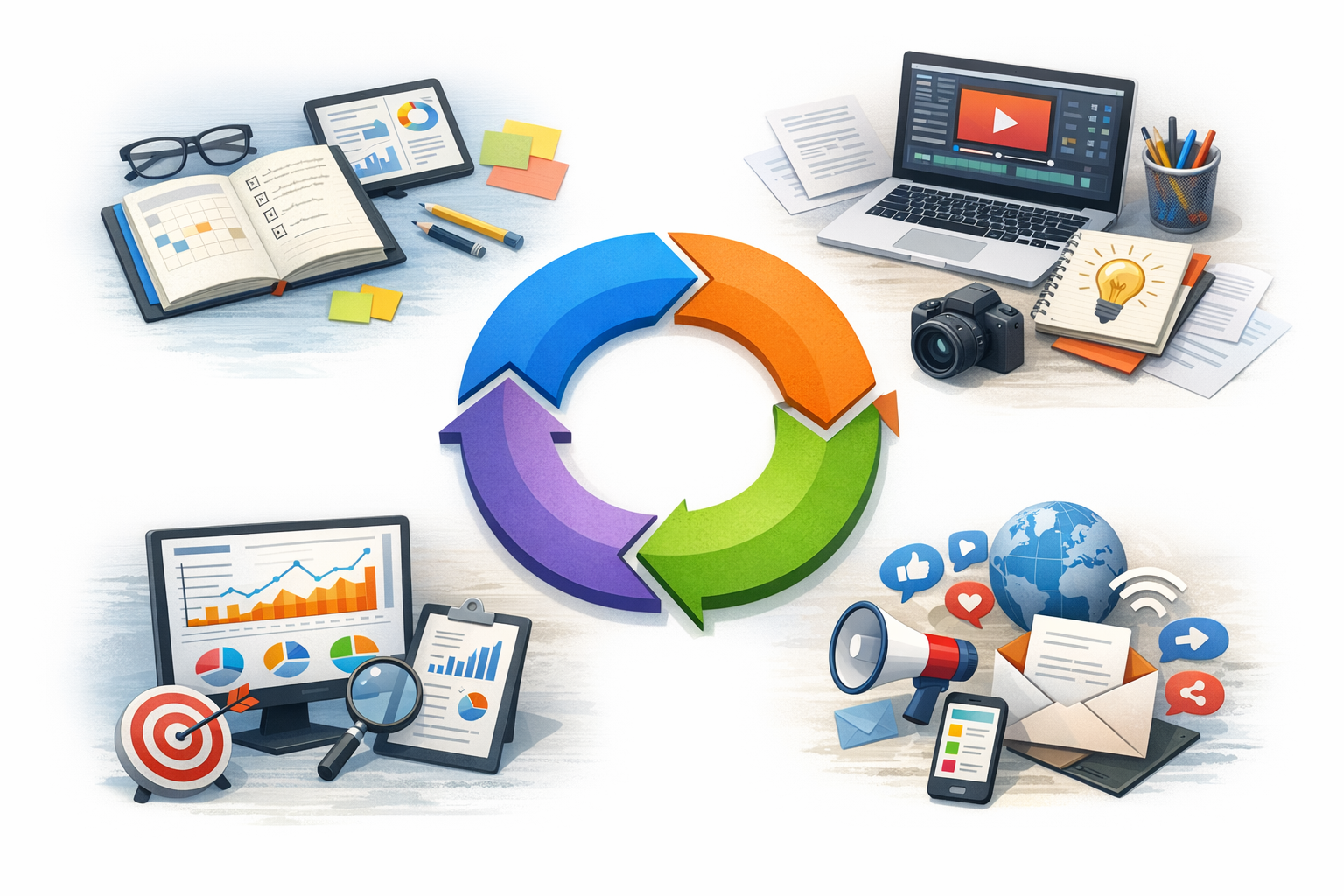
Successful content marketing rarely comes from “posting more.” It comes from a repeatable content marketing framework: a structured way to decide what to publish, why it matters, where it will go, and how you’ll know it worked. This guide walks you through a comprehensive framework you can adapt to almost any business—B2B, eCommerce, local services, SaaS, and beyond.
What Is a Content Marketing Framework?
A content marketing framework is a system that connects your business goals to your audience’s needs through a consistent process for planning, creating, distributing, and measuring content. Instead of relying on random ideas or trends, a framework helps you:
- Prioritize content that supports real outcomes (leads, sales, retention)
- Create consistent messaging across channels
- Scale production without sacrificing quality
- Measure performance and improve over time
The 8-Part Content Marketing Framework
Use the sections below as your “operating system” for content. Each part builds on the previous one, so you can implement it in phases if needed.
1) Set Clear Goals (and Tie Them to Business Outcomes)
Start by defining what content must achieve for the business. Avoid vague goals like “increase awareness” without a measurable definition.
Examples of strong goals:
- Generate 150 marketing-qualified leads (MQLs) per month from organic traffic
- Reduce customer churn by 10% through onboarding content and email education
- Increase demo conversion rate from 2% to 3% using comparison and proof content
Tip: Connect each goal to a metric you can track (traffic, conversion rate, pipeline influenced, retention rate) and a timeframe (quarterly is a good start).
2) Define Your Audience and Their “Jobs to Be Done”
A framework needs a clear picture of who you’re helping and what progress they’re trying to make. Basic personas are helpful, but go one level deeper: identify the job to be done (the outcome they want) and the barriers stopping them.
Capture:
- Primary audience segments (e.g., marketing managers, founders, procurement)
- Pain points and desired outcomes
- Decision criteria (price, trust, speed, compliance, integrations)
- Objections (risk, switching costs, internal buy-in)
When you document these, your content topics become much easier to prioritize—and much harder to copy.
3) Map Content to the Buyer Journey (Awareness → Consideration → Decision)
Many content programs fail because they overproduce top-of-funnel content and underproduce content that drives conversion. Balance your library across three stages:
- Awareness: Problem education (guides, checklists, “what is” articles)
- Consideration: Solution education (how-to, frameworks, templates, webinars)
- Decision: Proof and differentiation (case studies, comparisons, pricing pages, ROI tools)
Rule of thumb: If your goal is pipeline or revenue, ensure you’re consistently publishing decision-stage assets—not just traffic drivers.
4) Build Topic Pillars and a Content Matrix
Topic pillars keep your content focused and make it easier for audiences (and search engines) to understand what you’re known for. Choose 3–5 pillars that sit at the intersection of:
- What your audience needs
- What your product/service solves
- What you can credibly teach
Then create a simple content matrix to avoid random publishing:
- Rows: Buyer journey stages (Awareness, Consideration, Decision)
- Columns: Topic pillars
Fill each cell with 3–10 content ideas. You now have a roadmap that supports both growth and conversion.
5) Create a Repeatable Production Workflow
Great content doesn’t just happen—it’s produced. A framework defines roles, timelines, and quality standards so content can ship consistently.
A simple workflow:
- Brief: goal, audience, search intent, angle, key points, CTA
- Research: internal SMEs, customer interviews, competitor scan, data sources
- Draft: structure first, then writing
- Edit: clarity, credibility, brand voice, SEO, accessibility
- Design: diagrams, charts, screenshots, templates
- Publish: CMS formatting, internal links, CTAs, schema where relevant
- Repurpose: turn one asset into multiple channel pieces
Quality guardrails to document: tone guidelines, fact-checking standards, sourcing rules, and what “done” means (e.g., includes CTA + internal links + share snippets).
6) Plan Distribution (So Content Doesn’t Rely on Luck)
Publishing is not distribution. Build a distribution plan before you hit “publish,” with a mix of owned, earned, and paid channels.
Owned distribution examples:
- Email newsletter and nurture sequences
- Social posts (multiple angles across several weeks)
- In-app messages and knowledge base links
- Sales enablement: shareable one-pagers, sequences, and talk tracks
Earned distribution examples:
- Partner newsletters
- Podcasts and guest posts
- Community sharing (Reddit, Slack groups, forums—when appropriate)
Paid distribution examples:
- Boost best-performing posts
- Retarget decision-stage assets
- Sponsor relevant newsletters or creators
Practical tip: For every “pillar” piece, plan 10–20 repurposed outputs: short clips, quote cards, a carousel, a checklist, an email edition, and a sales asset.
7) Define Measurement: KPIs, Attribution, and Content Scorecards
Measurement is where frameworks become sustainable. Without it, content becomes a cost center instead of a growth engine.
Choose KPIs based on the funnel:
- Awareness: impressions, clicks, organic sessions, new users, engaged time
- Consideration: email sign-ups, webinar registrations, product page visits, content-assisted conversions
- Decision: demo requests, trials, SQLs, revenue influenced, win rate impact
Create a simple monthly content scorecard:
- Top 10 pages by growth (month-over-month)
- Top converting assets (by conversion rate and total conversions)
- Content decay list (pages losing traffic)
- Next actions: update, consolidate, republish, or expand
Don’t aim for perfect attribution on day one. Aim for consistent directional insight and decisions you can defend.
8) Governance: Calendar, Cadence, and Continuous Improvement
Governance is how you keep the system running. It includes planning rhythms, ownership, and ongoing optimization.
Key governance elements:
- Editorial calendar: topics, formats, stage mapping, owners, deadlines
- Content audits: quarterly reviews for pruning, updating, and internal linking
- Brand voice: consistent positioning and language
- Backlog management: a prioritized idea bank tied to pillars and goals
Optimization loop: publish → distribute → measure → improve → republish. Over time, this compounds performance and reduces reliance on constantly creating from scratch.
Example: Turning the Framework Into a Simple 30-Day Plan
If you want a quick start, here’s a practical way to implement the framework in one month:
- Week 1: define goals, pick 3–5 pillars, map journey stages, build your content matrix
- Week 2: write 2 briefs (one awareness, one decision), set templates for briefs and editing
- Week 3: publish 1 pillar article + 1 decision asset (case study or comparison)
- Week 4: repurpose into 10+ distribution pieces, set up scorecard reporting, plan next month
This creates immediate momentum while building the habits that make content reliable.
Common Mistakes to Avoid
- Chasing volume over focus: more posts won’t fix unclear positioning or weak distribution.
- Ignoring decision-stage content: traffic without conversion assets leads to disappointing ROI.
- No documented workflow: quality drops and timelines slip when process lives in people’s heads.
- Measuring only vanity metrics: impressions are useful, but they don’t replace pipeline metrics.
- Not updating older winners: refreshing proven content often beats publishing something new.
Conclusion
A strong content marketing framework gives you clarity, consistency, and compounding results. Start with goals and audience insight, build topic pillars, ship content through a repeatable workflow, distribute intentionally, and measure what matters. With that system in place, content becomes less of a guessing game—and more of a predictable growth channel.
