
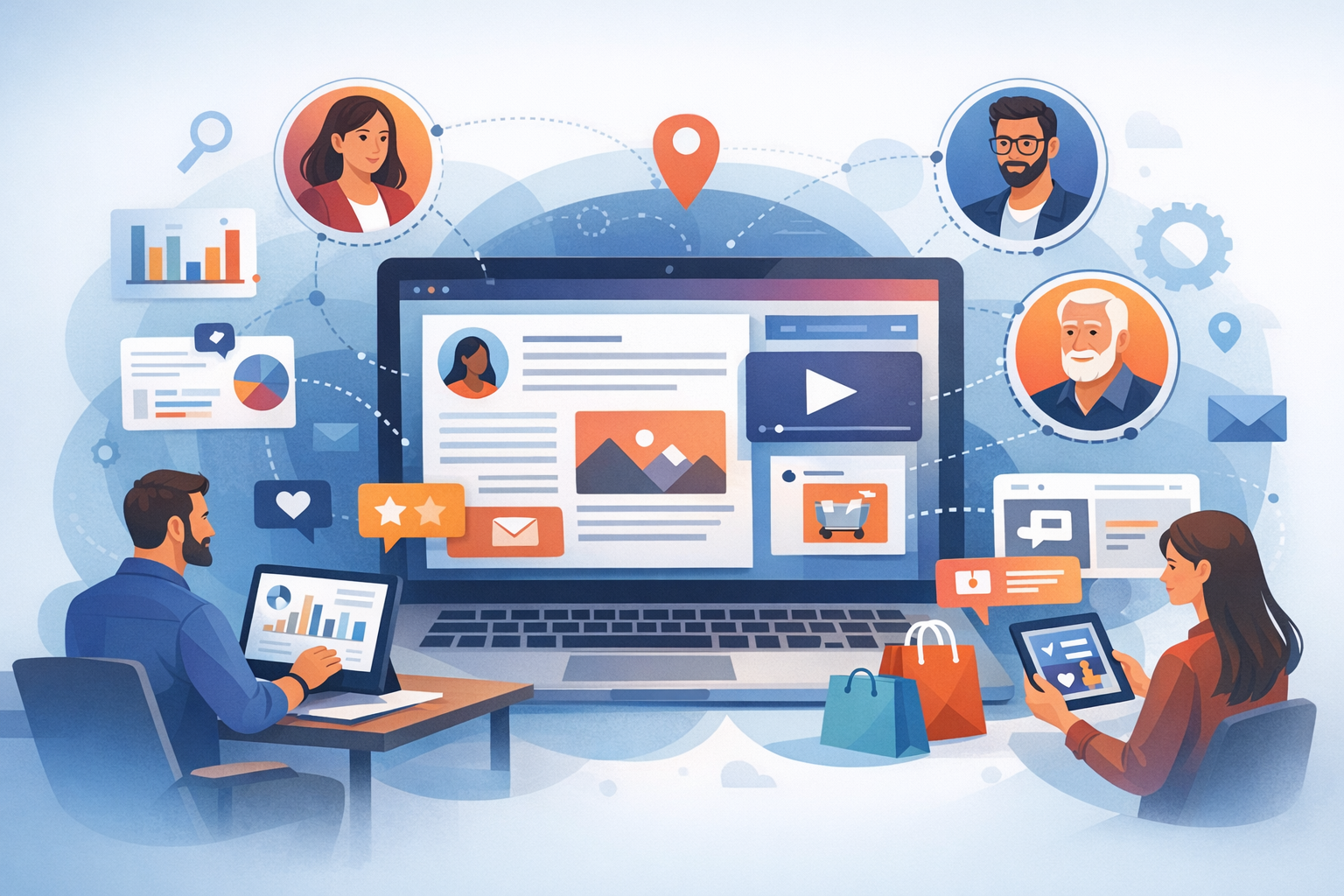
What is content marketing personalization?
Content marketing personalization is the practice of tailoring content experiences to specific audiences (and, when appropriate, individuals) based on data such as interests, behaviors, lifecycle stage, industry, location, or past engagement. The goal is simple: deliver the most relevant message to the right person at the right moment—without losing brand consistency.
Personalization can be as light as showing different homepage modules to new vs. returning visitors, or as advanced as serving dynamic email and on-site content based on product usage. The best personalization programs don’t feel “creepy” or overly invasive; they feel helpful—like your brand understands what the reader needs next.
Why personalization matters in content marketing
Today’s audiences are inundated with content, and generic messaging is easier than ever to ignore. Personalization helps you cut through the noise by aligning content to intent and context, which can lead to:
- Higher engagement: More clicks, longer sessions, and deeper scroll depth because content matches what people care about.
- Improved lead quality: Visitors who consume relevant content are more likely to convert and fit your ICP.
- Better retention and loyalty: Existing customers stay engaged when content supports adoption, education, and success.
- More efficient distribution: You get more value from each asset by matching it to the right segment or stage.
Personalization is also a competitive advantage. When your content feels tailor-made, it builds trust faster—and trust is what moves people from browsing to buying (and beyond).
Types of content marketing personalization
Not all personalization is the same. Choosing the right approach depends on your audience size, data maturity, tech stack, and content resources.
Audience segmentation
Segmentation groups people based on shared characteristics—then tailors messaging to each group. Common segmentation models include:
- Demographic: Role, seniority, company size, location
- Firmographic (B2B): Industry, revenue, tech stack, compliance needs
- Behavioral: Pages visited, content topics consumed, frequency of visits
- Lifecycle stage: Subscriber, lead, MQL, customer, power user
Segmentation is often the fastest way to start because it doesn’t require 1:1 content for every person—just a handful of smart variations that map to meaningful groups.
Dynamic content
Dynamic content changes what a user sees based on data rules. Examples include:
- Website banners that adjust by industry (e.g., healthcare vs. finance use cases)
- Product education hubs that prioritize modules based on the features someone uses
- Landing pages that swap testimonials or case studies based on segment
Dynamic content is powerful because it improves relevance without forcing your team to create and maintain dozens of separate pages.
Personalized email and nurture
Email remains one of the most effective channels for personalization because it’s inherently direct and measurable. Personalization in email can include:
- Content recommendations: “If you read X, you might like Y”
- Branching nurture paths: Different sequences based on clicks or replies
- Lifecycle messaging: Educational onboarding for new customers, advanced playbooks for experienced users
The key is to move beyond just first-name personalization and align content to intent and stage.
Website and landing page personalization
On-site personalization often delivers outsized results because it affects the moment of decision. You can personalize:
- Navigation: Highlight resources most relevant to a returning visitor or segment
- CTAs: “Book a demo” for high-intent visitors vs. “Download the guide” for early-stage readers
- Social proof: Case studies, logos, and testimonials aligned to industry or use case
Start with high-traffic pages (homepage, top blog posts, core landing pages) to maximize impact quickly.
Data you need (and what you don’t)
Effective personalization doesn’t require perfect data. It requires the right data—collected responsibly—and a clear plan for how you’ll use it.
First-party data sources
First-party data is information you collect directly from your audience, and it’s the most reliable foundation for personalization. Common sources include:
- Website analytics: Pages viewed, referrers, repeat visits, content topics
- Email engagement: Opens, clicks, replies, preference center choices
- CRM and marketing automation: Role, account data, lifecycle stage, lead source
- Product/app usage (if applicable): Features used, adoption milestones, renewal dates
- Forms and surveys: Self-reported goals, challenges, timelines
Contextual and behavioral signals
If you’re wary of over-collecting personal information, contextual signals can still deliver strong personalization. Examples:
- The content category a visitor is currently browsing (topic-based personalization)
- Device type or location for practical relevance (e.g., event invites by region)
- Engagement intensity (e.g., high-intent visitors see stronger CTAs)
This approach often feels more natural because it’s based on what someone is doing right now, not on hidden profiles.
Privacy and consent considerations
Personalization must be built on trust. Make sure you:
- Use clear cookie consent and provide easy opt-outs where required
- Explain what you collect and why in your privacy policy
- Limit sensitive data use and avoid personalization that feels intrusive
- Secure your data and restrict access internally
When in doubt, prioritize transparency and user control. The best personalization improves the experience without compromising privacy.
How to build a content personalization strategy
A successful personalization program is more than swapping a headline or adding a name token. It’s a system that connects audience insights, content operations, and measurement.
Define your audiences and goals
Start by identifying 3–5 core audience segments (or personas) that represent meaningful differences in needs. Then tie each segment to a business goal, such as:
- Increase subscriber-to-lead conversion
- Improve demo conversion rate on high-intent pages
- Increase product adoption for new customers
Clear goals help you decide what to personalize and how to measure success.
Map content to the customer journey
Personalization works best when it supports where someone is in their journey. Build a simple journey map across stages like:
- Awareness: Educational blog posts, trend reports, beginner guides
- Consideration: Comparisons, use cases, webinars, case studies
- Decision: Product pages, ROI tools, implementation guides, security docs
- Retention: Onboarding series, feature spotlights, best practices
Then decide where personalization will have the biggest lift—often at transition points (e.g., from blog reader to lead, from trial to customer).
Create content modules and variations
To personalize at scale, think in modules rather than entirely new assets. For example:
- A reusable “recommended resources” block that changes by topic or segment
- Case study panels that swap by industry
- CTA sets matched to lifecycle stage
Build a small library of approved modules and variations. This keeps quality high, reduces production time, and makes testing easier.
Choose the right tools (without overcomplicating)
You don’t need an enterprise stack to start. Many teams can begin with what they already have:
- Email platform: Segmented sends, dynamic blocks, behavior-based automation
- CMS: Category hubs, conditional content, personalization plugins
- Analytics: Events and conversions tied to segments
- CRM: Lifecycle stage and account segmentation
If you do evaluate personalization software, look for: easy rule-building, strong integrations, testing features, and clear reporting.
Best practices and examples
Great personalization is intentional and consistent. These best practices help you avoid common pitfalls and get better results faster.
Start small and scale what works
Pick one use case with a clear conversion point. For example:
- Personalize CTAs on your top 10 blog posts based on lifecycle stage
- Swap industry-specific case studies on a high-traffic product landing page
- Create a segmented newsletter with topic-based editions
Prove impact, document the process, and expand from there.
Use personalization to improve relevance—not just sales pressure
A common mistake is using personalization only to push harder CTAs. Instead, use it to be more helpful:
- Offer the next logical resource for the topic they’re exploring
- Provide implementation guidance for customers, not generic marketing
- Recommend formats that fit intent (e.g., checklist vs. webinar)
When the content truly helps, conversions tend to follow naturally.
Test and measure continuously
Personalization is a series of hypotheses. Test elements like:
- CTA language and placement by segment
- Recommended content logic (topic-based vs. popularity-based)
- Landing page hero copy by industry
Measure outcomes that match your goal: conversion rate, assisted conversions, time to next step, lead quality, retention metrics, and revenue influence where possible.
Common pitfalls to avoid
- Too many segments: Over-segmentation makes content operations unmanageable.
- Not enough content: Personalization fails if every segment sees the same assets.
- Inconsistent messaging: Dynamic modules must still feel like one coherent brand experience.
- “Creepy” execution: Avoid implying you know more than the user expects you to know.
Conclusion
Content marketing personalization is one of the most effective ways to improve relevance, engagement, and conversions—without simply producing more content. Start with a few meaningful segments, personalize high-impact moments in the journey, and scale through reusable modules and continuous testing. When personalization is grounded in helpfulness and trust, it creates the kind of content experience people actually want to return to.
