
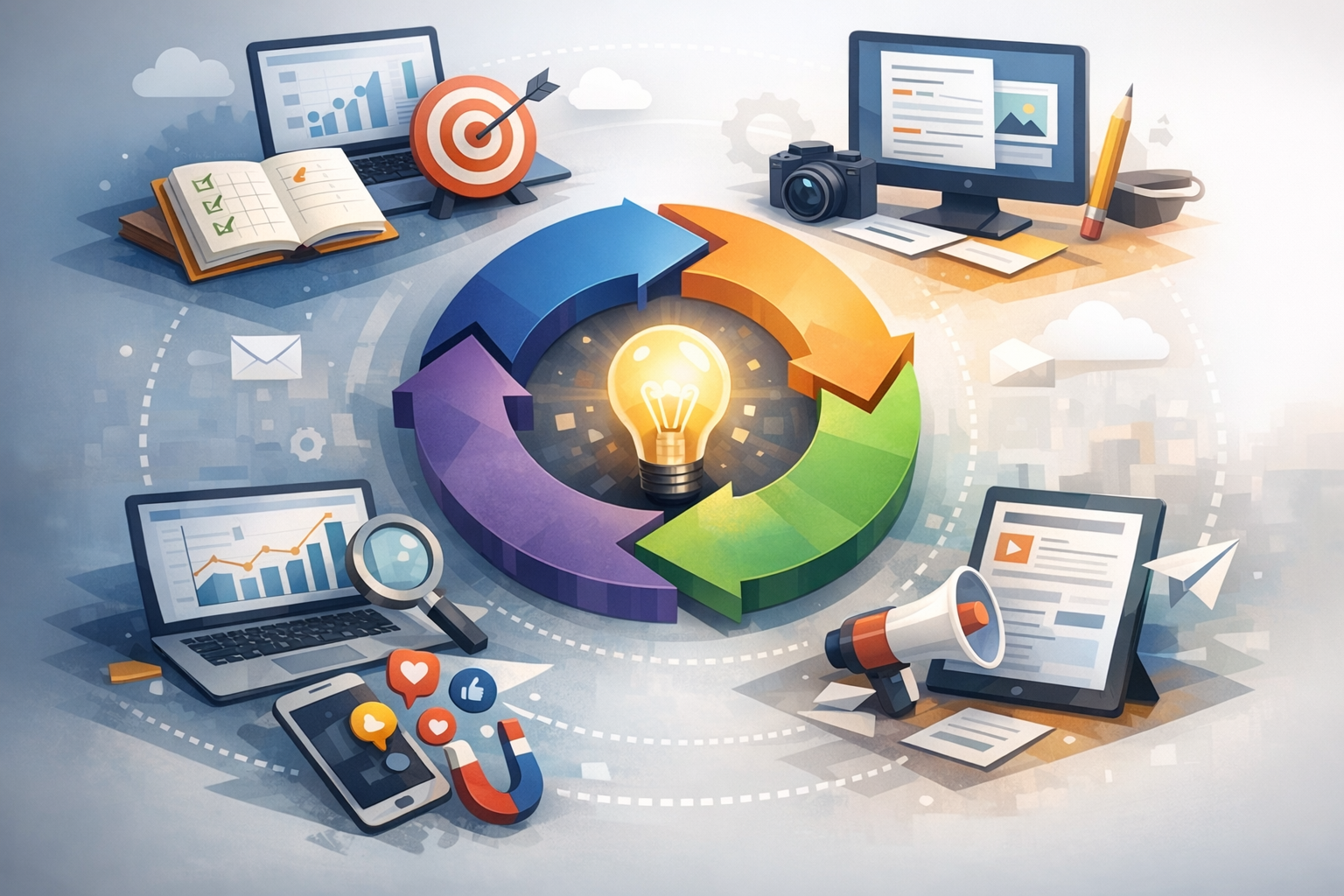
What Is the Content Marketing Lifecycle?
The content marketing lifecycle is the repeatable process of planning, creating, distributing, optimizing, and maintaining content so it consistently drives business results. Instead of treating each blog post, video, or email as a one-off project, the lifecycle approach helps you build a system—one that aligns content with audience needs, marketing goals, and measurable performance.
Most importantly, the lifecycle mindset keeps your content working over time. Great content doesn’t stop at publishing; it evolves based on data, feedback, and changing customer expectations.
Why the Content Marketing Lifecycle Matters
Content marketing can feel overwhelming because there are endless channels, formats, and ideas. A lifecycle framework brings structure and clarity. It helps you:
- Improve consistency: Maintain a reliable cadence without scrambling for last-minute ideas.
- Increase ROI: Repurpose and optimize what you’ve already created instead of constantly starting from scratch.
- Align teams: Clarify who owns strategy, creation, approvals, distribution, and reporting.
- Make performance measurable: Tie content to funnel stages, KPIs, and business outcomes.
- Scale sustainably: Build processes that work as you grow your content library.
Stage 1: Strategy & Planning
The lifecycle begins with a strategy that answers three foundational questions: Who are we helping? What do they need? and What business goal does this support? Strong planning prevents content that looks good but fails to drive meaningful results.
Define goals and KPIs
Start by choosing the outcomes you want your content to influence. Common content marketing goals include:
- Brand awareness (reach, impressions, share of voice)
- Organic traffic growth (sessions, keyword rankings)
- Lead generation (form fills, demo requests, email signups)
- Pipeline and revenue influence (content-sourced or content-assisted conversions)
- Customer retention (product adoption, support deflection, renewals)
Then attach a small set of KPIs to each goal. For example, if your goal is lead generation, track conversion rate, cost per lead (if paid distribution is involved), and lead quality signals (MQL rate, demo show rate, etc.).
Know your audience and map content to the funnel
Effective content is built on a clear understanding of your audience’s questions, objections, and decision-making triggers. Use a combination of customer interviews, sales/support feedback, search intent research, and analytics to shape your topics.
Next, map content to the customer journey:
- Awareness: Educational, problem-focused content (guides, blog posts, social videos)
- Consideration: Solution comparisons, use cases, webinars, case studies
- Decision: Product pages, demos, pricing explainers, ROI calculators, proof points
- Retention: Tutorials, onboarding sequences, knowledge base content, community posts
Create a content roadmap and editorial calendar
A roadmap prioritizes what to publish and why. An editorial calendar ensures it happens. Your roadmap should include:
- Primary themes/pillars (3–6 core topics you want to own)
- Target formats (blog, video, email, podcast, templates)
- Target channels (SEO, LinkedIn, YouTube, newsletters, partners)
- Production capacity (writers, designers, SMEs, approvals)
- Measurement plan (how you’ll evaluate success)
Stage 2: Creation & Production
This stage turns strategy into tangible assets. High-performing content is rarely just “well-written”—it’s structured for clarity, aligned to intent, and designed to be useful.
Research and ideation
Great topics come from multiple sources:
- Search data: Keyword research, SERP analysis, People Also Ask questions
- Internal expertise: Product, customer success, and sales insights
- Customer signals: Reviews, community discussions, support tickets, onboarding questions
- Competitive gaps: Topics competitors cover poorly—or not at all
For each content idea, clarify the primary intent (informational, commercial, navigational), the main takeaway, and the next step you want the reader to take.
Write, design, and build with quality standards
To keep quality consistent across authors and formats, establish production standards such as:
- Voice and tone guidelines (how you sound)
- Formatting rules (headings, bullets, scannability)
- Evidence requirements (data sources, examples, screenshots)
- Brand design elements (templates for visuals, thumbnails, charts)
Quality content is also accessible: clear headings, readable typography, descriptive links, and image alt text. These details help both users and search engines.
Review and approval workflow
A smooth workflow avoids bottlenecks. Define who reviews for:
- Accuracy: Subject matter experts (SMEs)
- Brand and messaging: Marketing lead or editor
- Compliance (if needed): Legal/regulatory review
Set expectations for turnaround times and feedback style (e.g., consolidated comments rather than multiple conflicting edits).
Stage 3: Distribution & Promotion
Publishing is only the beginning. Distribution ensures your content reaches the right people, in the right places, at the right time.
Owned, earned, and paid channels
A strong content distribution plan usually blends:
- Owned: Website/blog, email list, social profiles, in-app messages
- Earned: PR mentions, backlinks, guest posts, community shares
- Paid: Social ads, search ads, sponsored newsletters, influencer partnerships
Match the channel to the content type. For example, a detailed guide may perform best through SEO and email nurturing, while short-form insights can be ideal for LinkedIn or Reels.
Repurposing for reach
Repurposing extends the lifecycle of a core asset. One long-form piece can become:
- A LinkedIn carousel or thread
- A short video script
- Newsletter highlights
- A webinar outline
- Sales enablement snippets (battlecards, objection handling)
This approach saves production time while increasing frequency and consistency across channels.
Distribution checklists and timing
Create a repeatable checklist so each launch is consistent. Include:
- On-page SEO basics (title, meta, internal links)
- Email announcement copy and segmentation
- Social versions (multiple hooks and creatives)
- Community/partner sharing plan
- UTM parameters for tracking
Also consider timing: publish when your audience is most active, then re-share strategically over the following weeks with new angles.
Stage 4: Measurement & Performance Analysis
Measurement turns content into a controllable growth lever. Without it, you can’t confidently repeat what works or fix what doesn’t.
Key metrics to track
Choose metrics based on the role of the content:
- Awareness: impressions, reach, new users, branded search growth
- Engagement: time on page, scroll depth, video retention, shares, comments
- SEO: rankings, clicks, CTR, backlinks, internal link impact
- Conversion: CTA clicks, signups, demo requests, assisted conversions
- Revenue impact: pipeline influenced, deal velocity changes, retention signals
Track performance at both the individual content level (which pieces win) and the program level (whether the system is improving over time).
Attribution and context
Content often influences decisions before a buyer converts. Use a mix of attribution views (first-touch, last-touch, and multi-touch) and qualitative feedback (sales notes, “how did you hear about us?” responses) to get a clearer picture.
Also compare content performance to benchmarks like historical averages and seasonal patterns. Not every dip is a failure—sometimes it’s timing, algorithm changes, or shifts in demand.
Stage 5: Optimization & Iteration
Optimization is where the lifecycle becomes compounding. Small improvements—made consistently—can produce large gains over time.
Refresh and update existing content
Content refreshes are one of the highest-ROI activities in content marketing, especially for SEO-driven programs. Prioritize updates for:
- High-traffic pages with declining rankings
- Posts that rank on page 2 (quick wins)
- Evergreen topics with outdated examples or stats
- Content with strong engagement but low conversion
Common improvements include updating sections, adding FAQs, improving internal linking, refining the intro for clarity, and strengthening the CTA to match intent.
A/B test messaging and conversion paths
Optimization isn’t limited to search. Test:
- CTA placement (top, middle, end)
- CTA wording (benefit-driven vs. action-driven)
- Lead magnet formats (checklist vs. template vs. mini-course)
- Landing page layouts and form length
Keep tests focused: change one variable at a time, run long enough to get meaningful results, and document learnings so they influence future content.
Stage 6: Governance, Maintenance & Scaling
As your content library grows, governance keeps it accurate, on-brand, and effective. This stage is often overlooked—but it’s essential for long-term performance.
Content audits and inventory management
Run periodic content audits (quarterly or biannually) to identify what to:
- Keep: top performers and evergreen assets
- Update: content that’s valuable but outdated
- Consolidate: overlapping posts competing for the same keywords
- Redirect/remove: content that no longer serves users or the business
Maintain a simple inventory spreadsheet or content hub tool with URLs, topics, funnel stage, publish date, and performance notes.
Documentation and team processes
Scaling content requires repeatable processes. Document:
- Editorial guidelines and SEO standards
- Brief templates and acceptance criteria
- Approval workflows and ownership
- Publishing and distribution checklists
- Reporting cadence and dashboards
This reduces reliance on tribal knowledge and makes onboarding faster when you add new writers, editors, or agencies.
Building a sustainable content engine
A sustainable content engine balances ambition with capacity. If you’re publishing frequently but quality drops, performance usually follows. Consider scaling with:
- Clear content pillars and series (easier to plan, easier to execute)
- SME-driven content programs (interviews, outlines, ghostwriting)
- Repurposing systems (one “hero” asset fuels many smaller pieces)
- Templates for briefs, outlines, visuals, and reporting
Conclusion
The content marketing lifecycle turns content from a set of isolated tasks into a system that improves with every cycle. When you plan intentionally, create with clear standards, distribute strategically, measure what matters, and continuously optimize, your content becomes a compounding asset—driving traffic, trust, and conversions long after the publish date.
If you want a simple next step, start by documenting your current process and adding one improvement at each stage. Over time, those small upgrades add up to a content program that’s easier to manage and much more effective.
