
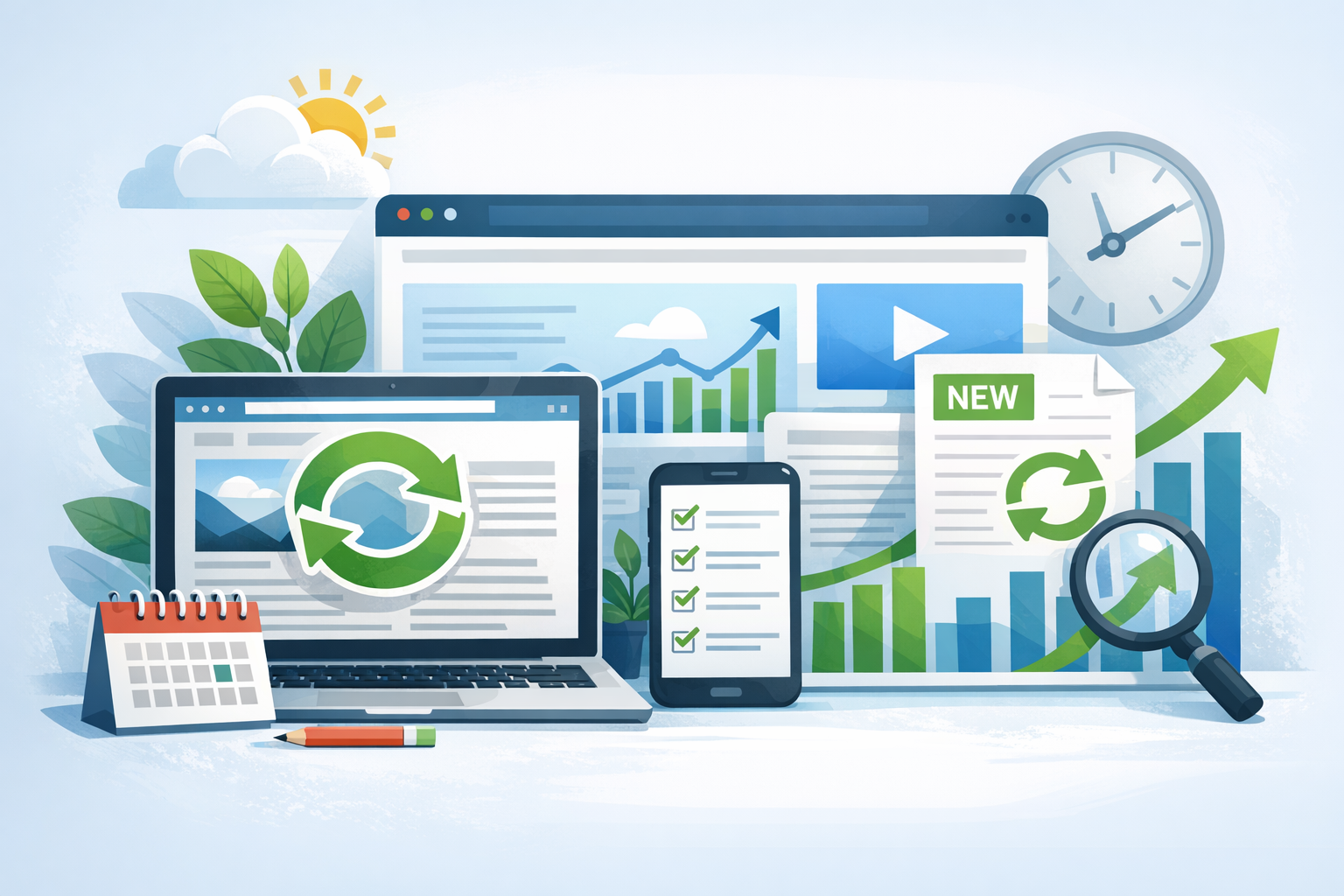
What Is Content Freshness?
Content freshness refers to how current, up-to-date, and relevant your website content is for users and search engines. Freshness can mean publishing something new, improving existing pages, updating facts and examples, or enhancing a post with better structure and media. It’s not just about “newness”—it’s about whether the content still accurately answers a searcher’s question today.
Fresh content helps you stay competitive in search results and trustworthy with readers. A guide written two years ago might still be useful, but if it references outdated tools, old statistics, or broken links, it slowly loses value. On the other hand, a well-maintained article that evolves with the topic can continue to drive traffic for years.
Why Content Freshness Matters (SEO + User Experience)
Content freshness impacts both how people perceive your brand and how search engines evaluate your pages. Even if you already rank well, freshness can help protect those rankings and improve performance over time.
Freshness and Search Intent
Search intent changes. New products launch, terminology evolves, and “best practices” shift. When content matches current intent—what people want now—it’s more likely to satisfy users. For example, a query like “best email marketing tools” typically expects current recommendations, pricing, and feature comparisons. A page that hasn’t been updated in a year may no longer match the intent behind that search.
Trust, Conversions, and Brand Credibility
Readers notice when content is outdated. Old screenshots, expired offers, or obsolete recommendations can reduce trust quickly—especially for topics tied to money, health, or business decisions. Freshness supports credibility, which improves conversion rates: more email signups, more demo requests, more purchases, and more backlinks from people who consider your page a reliable reference.
How Search Engines Think About Freshness
Freshness is not a single “score,” and it doesn’t apply equally to every query. Search engines aim to serve the most helpful result based on what the user likely needs—sometimes that’s the newest information, and sometimes it’s a timeless resource.
Query Deserves Freshness (QDF): When “New” Wins
Some searches have a strong freshness requirement. This is often described as “query deserves freshness” (QDF). Think of searches like:
- Breaking news or trending topics
- Product launches and release dates
- Annual lists (e.g., “best laptops 2026”)
- Fast-changing industries (AI tools, SEO, social media)
For QDF-style queries, recently updated pages and newly published content can have an advantage because the user expects current details.
Evergreen vs. Time-Sensitive Topics
Evergreen content covers topics that remain relatively stable over time—like explaining a concept, defining a term, or teaching a foundational process. Time-sensitive content depends heavily on current facts, trends, or options.
The key is to classify your pages correctly:
- Evergreen: “What is a content audit?” (update occasionally)
- Time-sensitive: “Best project management tools” (update frequently)
If you update everything constantly, you waste effort. If you never update time-sensitive pages, they decay fast. The best strategy is a balance based on topic type and performance.
Signs Your Content Is No Longer Fresh
Not sure which pages need attention? These are common indicators that a post is aging out:
- Traffic declines over time: Organic sessions trend down month-over-month.
- Rankings slip: Your page loses positions to newer or better-maintained competitors.
- Outdated information: Old stats, discontinued products, or changed regulations.
- Broken links: External sources 404, internal links point to removed pages.
- Low engagement: High bounce rate, short time on page, fewer scrolls.
- Mismatched intent: The SERP shows different content types than yours (e.g., video results, tool pages, recent lists).
- Old visuals: Screenshots from outdated interfaces or missing images.
Even strong content can become stale if competitors add better examples, clearer explanations, or newer data. Freshness isn’t about perfection; it’s about staying meaningfully current.
Content Freshness Strategies That Work
Keeping content fresh doesn’t always mean rewriting from scratch. The most effective approach is to pick the right update type for the page and the opportunity.
Update and Republish Existing Content
Refreshing a high-potential post is often faster than creating a new one—and it can produce big gains. A solid refresh typically includes:
- Updating outdated sections, statistics, and examples
- Adding missing subtopics that readers expect
- Improving clarity, formatting, and scannability
- Enhancing E-E-A-T signals (experience, expertise, author info, citations)
- Fixing internal and external links
If your CMS allows it, consider republishing with an updated date only when you’ve made substantial improvements. Small typo fixes typically don’t justify a republish.
Add New Sections Instead of Rewriting Everything
Sometimes the best freshness win is additive. If the core content is still accurate, you can modernize it by adding:
- A “What’s changed in 2026” section
- New FAQs based on current search results and user questions
- New screenshots, templates, or examples
- Updated step-by-step processes using current tools
This approach preserves existing rankings while improving completeness—often a strong signal that your page is the best result.
Refresh Internal Links and Site Structure
Internal linking is a practical freshness lever because it helps search engines understand which pages matter now. When you publish a new related post, link to it from older high-traffic pages. Also:
- Update anchor text to better match current topics
- Point outdated posts to newer, more relevant resources
- Build topic clusters (pillar pages + supporting articles)
Over time, a strong internal link structure keeps your site cohesive and improves both crawl efficiency and user navigation.
Use Content Pruning (Redirect, Consolidate, or Remove)
Freshness also means reducing outdated or low-value pages that drag down your site’s overall quality. Content pruning options include:
- Consolidate: Merge overlapping posts into one stronger resource.
- Redirect: 301 redirect thin or outdated pages to a relevant, updated page.
- Noindex: Keep the page for users but remove it from search results if it doesn’t belong in the index.
- Remove: Delete pages that no longer serve a purpose and have no meaningful traffic or links.
Pruning is especially helpful for older sites with years of blog content where multiple posts compete for the same keywords.
How to Build a Content Freshness Workflow
A repeatable workflow turns freshness from a stressful “someday” task into a routine growth system. The goal is to update the right pages at the right frequency.
Run a Content Audit
Start with an inventory of your indexable pages and pull performance metrics. A practical content audit includes:
- URL
- Primary topic/keyword
- Organic traffic (last 3–6 months vs. previous period)
- Top queries and current ranking positions
- Conversions assisted (email signups, leads, sales)
- Backlinks and internal links
- Last updated date
Then label each page: Keep as-is, Update, Consolidate, Redirect, or Remove.
Prioritize High-Impact Pages
Not all updates are equal. Prioritize pages that are most likely to produce measurable improvements:
- Posts ranking on page 2 (positions 11–20) with room to break into page 1
- High-traffic pages with declining engagement or conversions
- Pages with valuable backlinks that deserve preservation
- Content tied directly to product pages, services, or lead generation
A smart freshness plan often starts with 10–20 key URLs rather than trying to update everything at once.
Set a Refresh Cadence (Monthly, Quarterly, Annually)
Create a schedule based on content type:
- Monthly: Competitive “best of” lists, pricing comparisons, fast-moving tool roundups
- Quarterly: Strategy guides, platform-specific tutorials, SEO and marketing playbooks
- Annually: Evergreen definitions, foundational how-tos, brand storytelling content
Pair cadence with triggers, like updating immediately when a major product feature changes or when you notice ranking drops in key queries.
Measuring the Impact of Freshness
Updating content without measurement turns freshness into guesswork. Track before-and-after performance to understand what’s working and to justify continued investment.
- Rankings: Did priority keywords move up? Did you gain featured snippets?
- Organic traffic: Compare 28-day or 90-day windows post-update to pre-update.
- Engagement: Time on page, scroll depth, and bounce rate trends.
- Conversions: Leads, trials, purchases, and assisted conversions from updated pages.
- Indexation and crawl: Ensure updated pages are crawled and indexed promptly.
Also track qualitative outcomes: fewer support questions, better sales conversations, and stronger brand trust signals are often downstream benefits of keeping content current.
Conclusion
Content freshness is one of the most practical ways to improve SEO, user trust, and long-term performance without relying solely on publishing new posts. By auditing your content, prioritizing high-impact updates, and building a consistent refresh workflow, you can keep your site relevant in changing search results—and genuinely helpful to the people you want to reach.
