
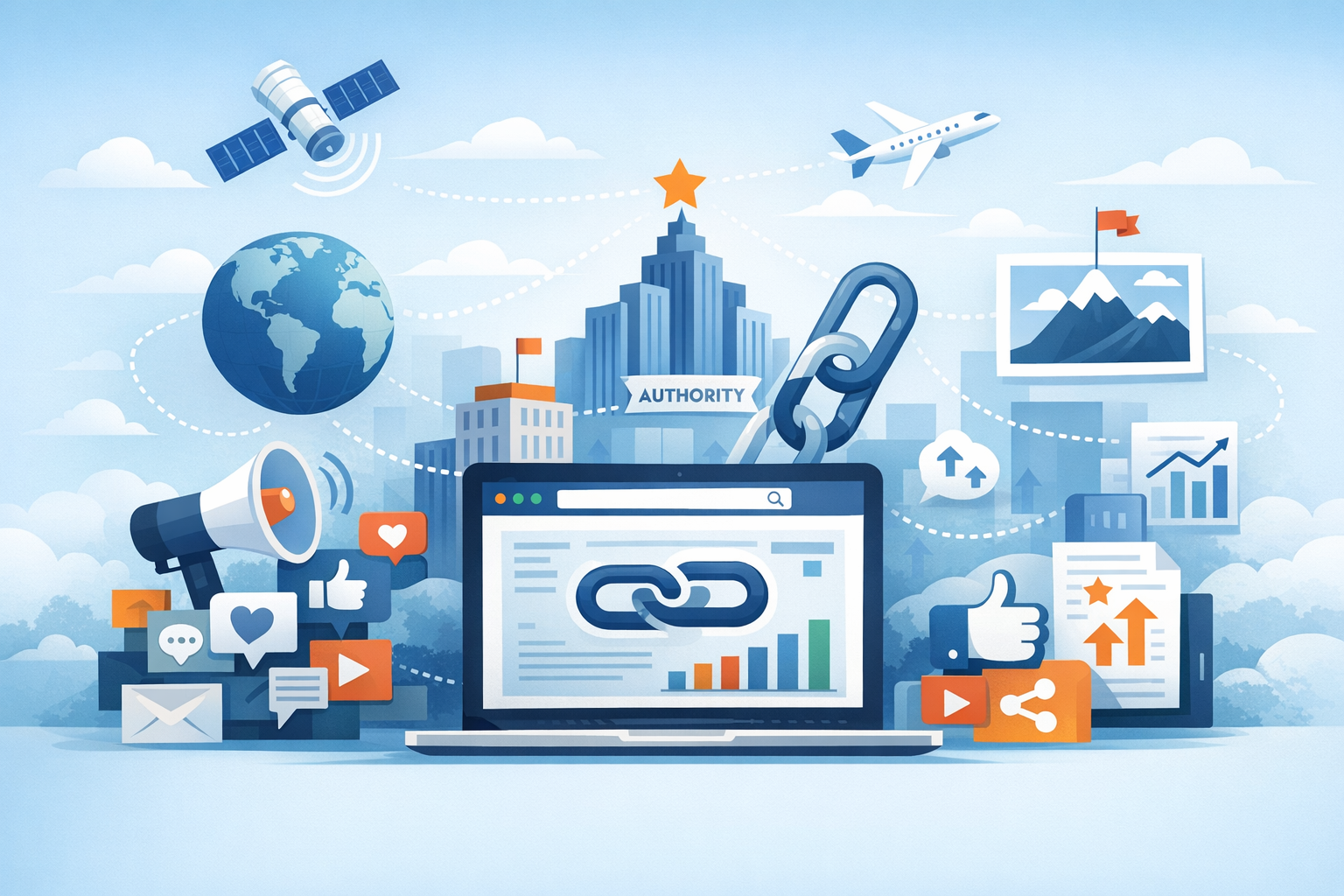
What Is Off-Page SEO?
Off-page SEO refers to the actions you take outside your website to improve its visibility in search engines. While on-page SEO focuses on optimizing your content, structure, and technical elements, off-page SEO is about building credibility, authority, and trust signals that search engines use to judge how valuable your site is to users.
The most well-known off-page SEO tactic is link building, but effective off-page optimization includes much more: brand mentions, digital PR, reviews, local citations, social amplification, influencer partnerships, and community engagement. In short, off-page SEO helps prove your website deserves to rank.
Why Off-Page SEO Matters
Search engines aim to show the most helpful and reliable results. If other reputable websites and people on the internet reference your brand, your content, or your business, it’s a strong signal that you’re trustworthy. Off-page SEO matters because it:
- Builds authority: High-quality backlinks and mentions from respected sites can improve your perceived expertise.
- Improves rankings: Competitive keywords often require strong off-page signals to outrank established competitors.
- Drives referral traffic: Links from relevant sites can send high-intent visitors directly to your pages.
- Strengthens brand trust: Reviews, PR coverage, and consistent citations can help users (and search engines) feel confident.
For many niches, off-page SEO is what separates “good content” from “top rankings.”
Core Off-Page SEO Factors
Off-page SEO covers a broad set of signals. The key is focusing on factors that influence authority and visibility while staying aligned with search engine guidelines.
Backlinks: Quality Over Quantity
Backlinks are links from other websites pointing to yours. They act like “votes,” but not all votes are equal. A few relevant, editorial links from trusted sites typically outweigh dozens of low-quality links.
When evaluating backlink quality, consider:
- Relevance: Links from sites in your industry or niche are more valuable.
- Authority: Well-established, reputable sites tend to pass more value.
- Editorial placement: Links placed naturally within content are generally stronger than footer/sidebar links.
- Anchor text: Descriptive anchors help provide context, but over-optimized anchors can look manipulative.
- Diversity: A natural profile includes links from multiple domains, not one source repeatedly.
Brand Mentions and Digital PR
Not every mention includes a clickable link, but brand mentions can still contribute to your overall online presence and perceived legitimacy. Digital PR focuses on earning coverage on news sites, industry publications, podcasts, and blogs.
Digital PR can support off-page SEO by:
- Generating high-authority editorial backlinks
- Increasing branded searches (people searching for your name)
- Expanding reach to audiences already interested in your topic
Examples include data-led reports, expert commentary, product launches, community initiatives, and thought leadership pieces.
Reviews and Reputation Signals
For local businesses and service providers, reviews are a major off-page factor. Reviews influence click-through rates, conversions, and local map visibility. They also help users decide whether to trust you.
To strengthen review signals:
- Ask for reviews consistently (after successful transactions or support interactions).
- Respond to reviews professionally—especially negative ones.
- Encourage detailed reviews that naturally describe services or products.
- Monitor platforms like Google Business Profile, Yelp, Trustpilot, and industry-specific directories.
Local Citations and Directory Listings
A citation is any online mention of your business name, address, and phone number (often called NAP). Citations help search engines confirm your business details and improve local search presence.
Best practices:
- Consistency is critical: Ensure NAP matches everywhere (same formatting and details).
- Prioritize quality directories: Focus on reputable general and niche directories.
- Keep listings updated: Fix duplicates and outdated info quickly.
Social Signals and Content Amplification
Social media links are typically “nofollow,” meaning they don’t always pass direct ranking value like traditional backlinks. However, social platforms can amplify content, increase visibility, and attract links organically when the right people discover your work.
Social can help by:
- Driving early traffic to new content
- Increasing the likelihood of earning editorial links
- Growing your audience for future campaigns
Community Engagement and Partnerships
Off-page SEO is also built through genuine relationships. Contributing to communities, collaborating with partners, and supporting industry initiatives can lead to natural links and mentions.
Ideas include:
- Partner pages and integrations
- Co-hosted webinars or events
- Scholarships or community sponsorships (used ethically)
- Active participation in forums and professional groups
Off-Page SEO Strategies That Work
Off-page SEO is most effective when it’s intentional, repeatable, and focused on quality. Below are strategies widely used to earn sustainable authority.
Create Link-Worthy Assets
Some content is simply easier to earn links to. These are often “assets” that others reference because they save time, add credibility, or provide unique value.
Common link-worthy assets include:
- Original research, surveys, and industry reports
- Free tools, calculators, and templates
- Definitive guides and evergreen tutorials
- Curated resource lists (kept up to date)
- High-quality visuals, charts, and infographics
Tip: build the asset around a topic that already earns links in your niche, then make yours more current, more detailed, or more useful.
Guest Posting (Done the Right Way)
Guest posting can be effective when the goal is to contribute expertise to a relevant publication—not to mass-produce links. High-quality guest posts can earn referral traffic, strengthen your reputation, and generate natural editorial links.
Best practices:
- Choose sites closely aligned with your audience and industry.
- Pitch specific article ideas that match their style and gaps.
- Prioritize thought leadership and practical value over promotional content.
- Use branded or natural anchor text for links, and link only where it genuinely helps readers.
Broken Link Building and Link Reclamation
Broken link building involves finding broken outbound links on other websites and suggesting your content as a replacement. Link reclamation focuses on fixing lost links or turning unlinked brand mentions into links.
Quick wins often come from:
- Finding unlinked mentions of your brand and politely requesting a link
- Identifying pages that used to link to you but now point to a 404 or a changed URL
- Updating and improving the page you want them to link to (so it’s clearly the best alternative)
HARO and Expert Quote Opportunities
Journalists and bloggers frequently seek expert input for articles. Responding to these requests can earn high-authority mentions and backlinks.
To improve success:
- Reply quickly and follow the requested format.
- Offer concise, original insights (not generic definitions).
- Provide credentials and a relevant link to your site.
Influencer and Creator Collaboration
Partnering with creators can expand reach and naturally generate mentions, reviews, and links—especially if the collaboration produces something genuinely useful (a tutorial, case study, or joint event).
Look for creators whose audience overlaps with yours and whose content style matches your brand. Focus on long-term relationships rather than one-off promotions.
What to Avoid: Off-Page SEO Mistakes and Risks
Off-page SEO can backfire if it relies on manipulative tactics. Search engines are increasingly good at detecting unnatural link patterns.
Buying Links and Link Schemes
Paying for links that pass ranking value, participating in private blog networks (PBNs), or exchanging links at scale can lead to penalties or long-term suppression. Even if you see short-term gains, it’s rarely worth the risk.
Low-Quality Directories and Spammy Citations
Submitting your site to hundreds of low-quality directories can dilute your backlink profile and waste time. In local SEO, a handful of strong, consistent citations usually beats mass submission.
Over-Optimized Anchor Text
Using the same exact-match keyword anchor repeatedly is a red flag. A natural profile includes branded anchors, URL anchors, and varied phrases that make sense in context.
Ignoring Relevance
A link from a high-authority site is not automatically a great link if it’s unrelated to your topic. Relevance is often what makes links impactful and safe.
How to Measure Off-Page SEO Success
Because off-page SEO impacts authority and perception, measuring success requires looking beyond rankings alone. Track a mix of SEO and business metrics.
Key Metrics to Monitor
- Referring domains: Growth in the number of unique sites linking to you.
- Link quality: Relevance and authority of new links (and the pages they point to).
- Organic rankings: Movement for priority keywords (especially competitive terms).
- Referral traffic: Visits coming from earned links and PR coverage.
- Branded search: More searches for your company/product name can signal increasing awareness.
- Local visibility: For local businesses, monitor map pack rankings and review volume/quality.
Tools You Can Use
Popular tools for off-page SEO measurement include Google Search Console (for top linking sites and pages), Google Analytics (for referral traffic), and third-party SEO platforms for backlink analysis and competitive comparisons.
Off-Page SEO Checklist (Quick Start)
- Audit your backlink profile and identify toxic or irrelevant patterns
- Create (or improve) at least one link-worthy asset
- Build a targeted outreach list of relevant publications and blogs
- Reclaim unlinked brand mentions and fix lost links
- Strengthen local citations and review generation (if applicable)
- Promote content through social and email to increase discovery
- Track referring domains, referral traffic, and keyword movement monthly
Conclusion
Off-page SEO is about earning trust at scale. By focusing on high-quality backlinks, brand mentions, reputation signals, and genuine relationships in your industry, you build the authority that helps your content compete and rank long-term. Start with strategies that prioritize relevance and value, measure results consistently, and avoid shortcuts that can put your site at risk.
