
What Is Sentiment Monitoring?
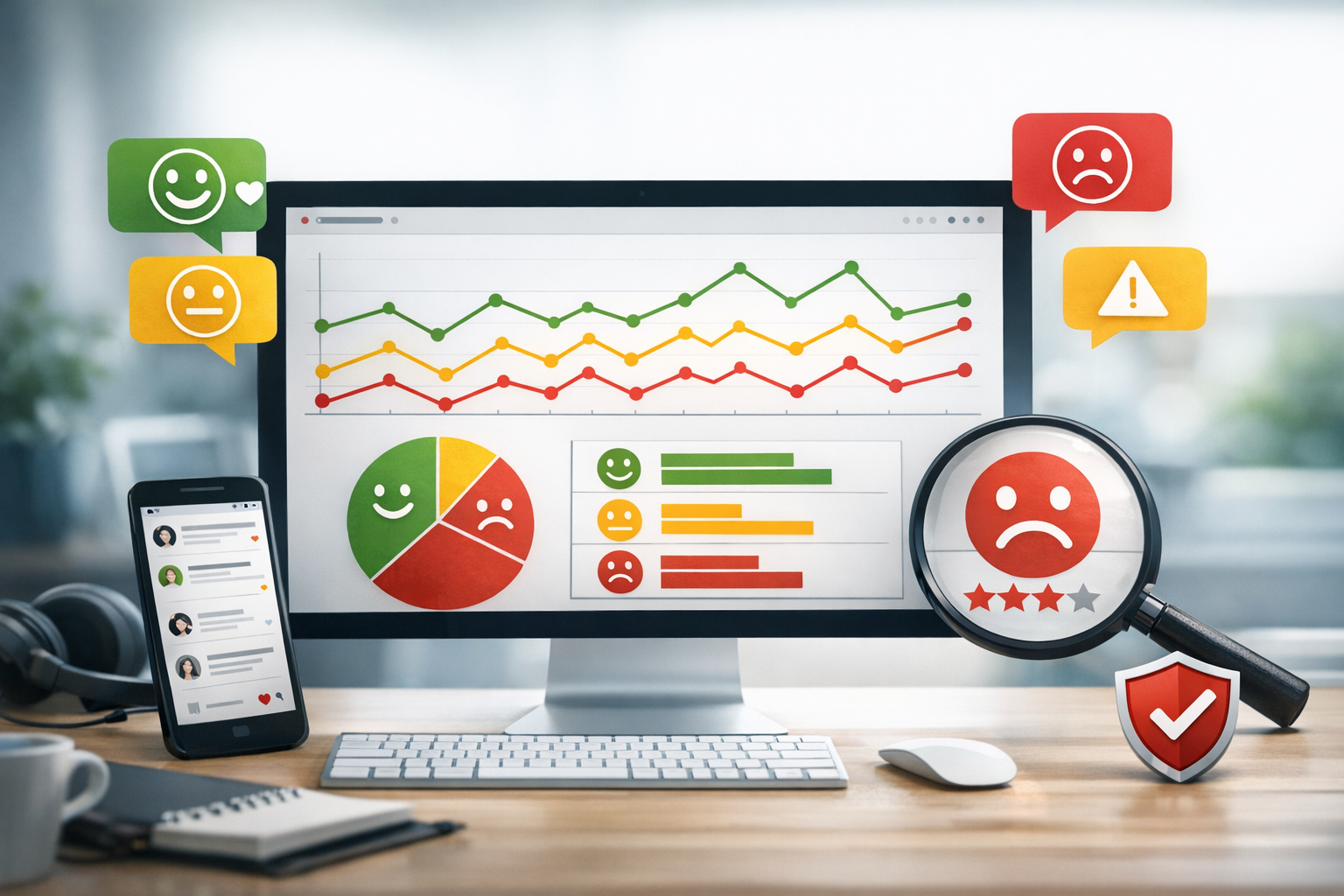
Sentiment monitoring is the process of tracking and analyzing the emotions and opinions people express about your brand, products, services, or industry across digital channels. Instead of only counting mentions or engagement, sentiment monitoring focuses on how people feel—positive, negative, or neutral—and why.
At its core, sentiment monitoring combines social listening, customer feedback analysis, and natural language processing (NLP) to surface patterns in conversations. Done well, it helps teams understand customer perception in near real time, identify emerging risks, and spot opportunities to improve experiences.
Sentiment monitoring vs. social listening
Social listening typically tracks what people are saying (topics, volume, share of voice, influencers, and trends). Sentiment monitoring is a deeper layer that interprets the tone behind those conversations. In practice, the best programs use both:
- Social listening answers: “What are people talking about?”
- Sentiment monitoring answers: “How do they feel about it, and what’s driving that emotion?”
Why sentiment matters more than volume
A spike in mentions isn’t always good news. A campaign can generate a lot of buzz while damaging trust if the sentiment is overwhelmingly negative. Sentiment adds context to raw metrics—helping you distinguish between healthy awareness and a brewing reputation issue. It also reveals subtle shifts: a gradual rise in frustration about a feature, delivery times, or support quality might appear in sentiment weeks before it shows up in churn.
Why Sentiment Monitoring Is Important
Sentiment monitoring is a practical tool for brand protection and growth. It gives you an early warning system and a clearer understanding of how customers experience your business.
Protect brand reputation in real time
Reputation can change quickly. A single viral post, product defect, or customer service misstep can cascade across platforms. Sentiment monitoring helps you detect unusual negativity early, identify where it’s spreading, and respond before it becomes a full-blown crisis.
Improve customer experience and retention
Sentiment often points to friction in the customer journey: confusing onboarding, unexpected fees, poor packaging, or inconsistent support. Tracking sentiment by topic (billing, shipping, product quality, app performance) helps teams prioritize fixes that will reduce complaints and improve loyalty.
Measure campaign and product impact
Beyond vanity metrics, sentiment helps you evaluate whether your initiatives are landing well. For example, a new pricing model may increase sign-ups while also increasing negative sentiment about value. Monitoring sentiment alongside conversions gives a more complete view of performance.
Competitive insights and market trends
Sentiment monitoring isn’t only about your brand. Tracking competitor sentiment and industry conversations can reveal gaps in the market, unmet needs, and opportunities to differentiate. If customers consistently complain about a competitor’s support responsiveness, that’s a clear area to highlight and invest in.
Key Data Sources for Sentiment Monitoring
A strong sentiment program looks beyond one channel. Customers share opinions across public and private spaces—each with different signals and limitations.
Social media platforms
Platforms like X (Twitter), Instagram, TikTok, LinkedIn, Facebook, Reddit, and community forums contain high-velocity, opinion-rich discussions. Social is ideal for detecting emerging issues and tracking how narratives evolve, but it can skew toward extreme opinions and is sensitive to algorithmic amplification.
Reviews and ratings sites
G2, Capterra, Google Reviews, Yelp, Amazon, and app store reviews provide structured feedback tied to a specific purchase or experience. Reviews are often highly actionable because they include context, comparisons, and expectations—perfect for topic-based sentiment analysis.
Customer support interactions
Tickets, chat transcripts, call center notes, and email threads are some of the most valuable sentiment sources because they’re directly linked to real customer problems. Monitoring sentiment here can highlight operational bottlenecks and training needs, and it often reveals issues before customers complain publicly.
Surveys and NPS comments
Survey open-text responses add depth to numeric satisfaction scores. Combining NPS/CSAT with text sentiment helps explain why scores moved and what to fix. Even small volumes can be powerful because survey comments are usually specific.
How Sentiment Analysis Works
Sentiment monitoring typically relies on automated sentiment analysis, supported by human review for nuance and accuracy. The goal is to turn unstructured text into measurable insights you can track over time.
Rule-based vs. machine learning approaches
- Rule-based systems use dictionaries and patterns (e.g., “love,” “hate,” “refund,” “broken”). They’re fast to implement and transparent, but they can struggle with slang, context, and evolving language.
- Machine learning (ML) models learn from examples and can handle more nuance. They often deliver better accuracy at scale, but they require training data, ongoing tuning, and careful evaluation.
Common sentiment categories and scoring
Most tools classify sentiment into three categories: positive, negative, and neutral. Many also provide a numeric score (for example, from -1 to +1) and a confidence level. More advanced setups include emotion detection (joy, anger, disappointment) and intent (purchase, complaint, cancellation), which can make alerts and routing more effective.
Challenges: sarcasm, context, and multilingual content
Sentiment analysis isn’t perfect. Sarcasm (“Great, another outage…”) can flip meaning. Context matters (“This is sick” can be positive), and different communities use different language norms. Multilingual monitoring adds complexity—direct translation can miss tone and idioms. The best approach combines automated scoring with sampling and human QA, especially for high-risk topics.
Building an Effective Sentiment Monitoring Strategy
Sentiment monitoring works best when it’s tied to clear goals and operational workflows—not just dashboards. Here’s how to set up a program that teams actually use.
Define goals and KPIs
Start with what you want to achieve. Common goals include early crisis detection, improving product quality, reducing churn, or measuring brand health. Align on KPIs such as:
- Net sentiment score (positive minus negative)
- Negative sentiment rate by topic
- Time to detection and time to response
- Sentiment changes after releases or campaigns
- Resolution rate and sentiment recovery after support interactions
Choose topics, keywords, and entities to track
Build a tracking framework that includes:
- Brand terms: brand name, product names, common misspellings
- People and entities: executives, spokespeople, store locations
- Product themes: features, integrations, pricing, reliability
- Experience topics: shipping, returns, onboarding, support
Organizing sentiment by topic is what turns monitoring into action—teams can own specific areas and measure improvement.
Set up alerts and escalation workflows
Create rules that trigger alerts when sentiment changes significantly or when high-impact posts appear (e.g., large follower count, media outlets, verified accounts, or high engagement). Define who gets notified and what happens next:
- Marketing/Comms: public response and messaging
- Support: customer outreach and resolution
- Product/Engineering: bug triage and incident management
- Legal/Compliance: sensitive issues when needed
Document escalation tiers (informational, urgent, critical) so decisions aren’t made under pressure.
Combine automated tools with human review
Automation is essential for scale, but human judgment ensures accuracy and prevents overreaction. A practical system is:
- Use automation for tagging, scoring, and trend detection.
- Review a sample of classified posts weekly to audit accuracy.
- Create a “gold set” of annotated examples to improve models and rules over time.
Tools and Features to Look For
Sentiment monitoring tools range from social media platforms to dedicated voice-of-customer suites. The best option depends on your channels, budget, and workflow needs.
Dashboards, integrations, and reporting
Look for dashboards that can segment sentiment by channel, product line, geography, and topic. Integrations matter just as much—especially with your CRM, help desk, and BI tools—so insights move to the teams that can act on them. Scheduled reports are useful for executives, while real-time views help front-line teams.
Custom models, topic clustering, and intent detection
Out-of-the-box sentiment is a starting point. Strong platforms allow customization, such as:
- Industry- and brand-specific language tuning
- Topic clustering to discover emerging themes automatically
- Intent detection (complaint, cancellation, purchase interest)
- Emotion analysis for better prioritization
Data privacy and compliance considerations
Sentiment monitoring often touches customer data. Ensure your approach supports relevant requirements (such as GDPR/CCPA) and internal policies. Key questions include data retention rules, access controls, audit logs, and whether you can anonymize sensitive fields in support transcripts or surveys.
Best Practices and Common Pitfalls
Even with great tools, sentiment monitoring can fail if the data is misread or the organization can’t act on it. These best practices help keep your program accurate and useful.
Validate sentiment accuracy with sampling
Regularly review a sample of mentions to check whether sentiment classification matches reality. Track accuracy by channel and topic—sarcasm-heavy platforms or niche communities often need extra attention. If you’re using sentiment as an operational trigger, accuracy checks are non-negotiable.
Watch for bias and skewed datasets
Not every customer segment posts online, and different platforms attract different demographics and communication styles. A small number of highly vocal users can distort perceived sentiment. Counterbalance public sentiment with first-party data (support tickets, surveys) to get a more representative view.
Turn insights into action with clear ownership
Dashboards don’t fix problems—teams do. Assign owners to key topics (e.g., “shipping delays,” “billing confusion,” “app performance”) and create a feedback loop:
- Detect sentiment shift
- Identify drivers and affected segments
- Implement changes
- Measure sentiment recovery and operational outcomes
Conclusion
Sentiment monitoring helps you understand the emotional reality behind customer feedback—so you can respond faster, improve experiences, and protect trust. By combining the right data sources, reliable analysis, and clear workflows, you turn scattered conversations into a practical system for decision-making and continuous improvement.
