
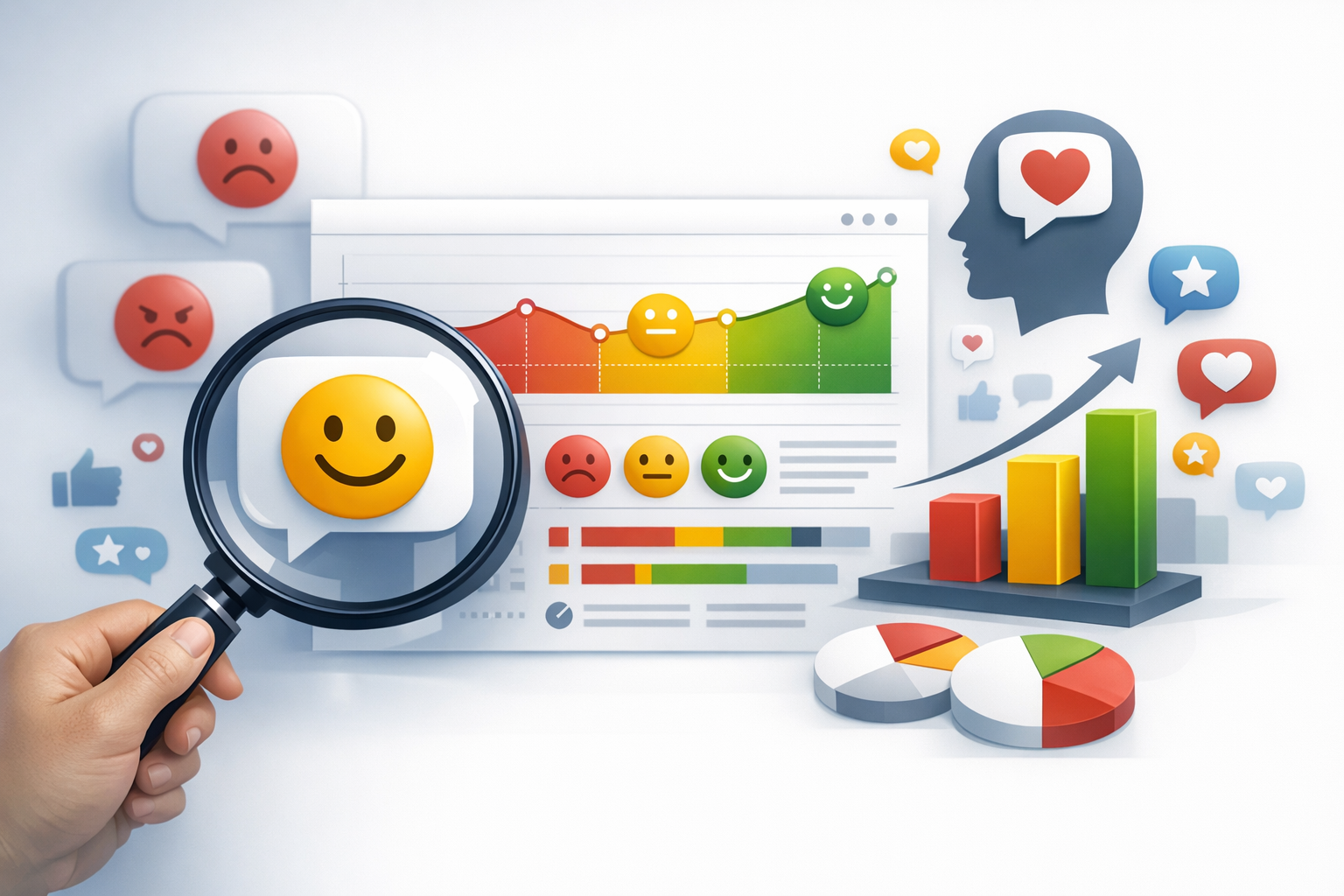
What is brand sentiment tracking?
Brand sentiment tracking is the ongoing process of measuring how people feel about your brand across channels like social media, review sites, customer support tickets, surveys, communities, forums, and the news. Instead of focusing only on how often you’re mentioned, sentiment tracking focuses on the emotional tone of those mentions—typically categorized as positive, negative, or neutral, and sometimes broken down into specific emotions (e.g., trust, frustration, excitement).
At its core, sentiment tracking answers questions like:
- Are perceptions improving or declining over time?
- What topics or product issues are driving negative sentiment?
- Which campaigns or launches are creating positive buzz?
- How does our sentiment compare to competitors?
Why brand sentiment tracking matters
Brand sentiment is a leading indicator of revenue, retention, and reputation. If sentiment deteriorates, you’ll often see downstream impacts—lower conversion rates, higher churn, increased support load, and greater price sensitivity. When sentiment improves, it typically correlates with stronger word-of-mouth, higher loyalty, and more resilient brand equity.
Here’s why sentiment tracking belongs in your regular reporting:
- Protects your reputation: Early detection of negative trends helps prevent minor issues from becoming crises.
- Improves customer experience: Sentiment surfaces friction points that traditional analytics may miss.
- Strengthens marketing effectiveness: You can connect campaign messaging to real customer reactions, not just clicks.
- Supports product decisions: Sentiment around features, bugs, pricing, or UX can guide prioritization.
- Enables competitive insight: Tracking competitors shows where they’re winning or losing customer trust.
What to track: key brand sentiment metrics
Sentiment tracking works best when you combine qualitative insight (what people are saying) with quantitative metrics (how much and how strongly). Below are the most useful metrics to monitor consistently.
1) Net sentiment score
A common metric is Net Sentiment, which balances positive and negative mentions. A simple version:
- Net Sentiment = % Positive − % Negative
This makes it easy to track trends over time and compare periods (pre-launch vs. post-launch, or last month vs. this month). Always pair it with volume and context, because a small number of highly negative posts can be more damaging than a larger number of mild complaints.
2) Sentiment volume and share of voice
Mention volume tells you how much conversation exists, while share of voice compares your mentions to competitors. Combine those with sentiment to spot patterns like:
- You have higher mention volume than a competitor, but worse sentiment (visibility without trust).
- A competitor’s positive sentiment is growing quickly—potentially due to a new feature or campaign.
3) Topic-level sentiment
Overall sentiment can hide the “why.” Topic-level sentiment breaks down feelings by category, such as:
- Product quality
- Shipping and delivery
- Customer support
- Pricing and billing
- Brand values and trust
This is where sentiment tracking becomes actionable—because you can assign owners and fix root causes.
4) Sentiment by channel
Sentiment varies by where people talk. For example, social media may skew more reactive, while review sites reflect considered experiences. Track sentiment by channel to avoid misinterpretation and to route responses effectively.
5) Sentiment velocity (trend direction)
How quickly sentiment changes matters as much as the score itself. A sudden spike in negativity often signals:
- An outage or service disruption
- A policy change
- A PR issue
- A product bug after release
Velocity metrics help teams act quickly and coordinate across marketing, support, product, and comms.
How brand sentiment tracking works (step-by-step)
A reliable sentiment program combines data collection, classification, analysis, and action. Here’s a practical workflow most teams can implement.
Step 1: Define goals and success criteria
Start by clarifying what you want sentiment tracking to achieve. Common goals include:
- Reduce negative sentiment tied to support issues
- Measure campaign perception beyond engagement
- Detect reputation risks earlier
- Benchmark sentiment against competitors
Then define what “good” looks like: a target net sentiment range, a maximum acceptable negative spike, or a goal to improve topic sentiment (e.g., billing) by a set amount.
Step 2: Choose data sources and keywords
Select sources based on where your customers actually speak. Typical sources include:
- Social platforms (e.g., X, Instagram, TikTok, LinkedIn)
- Review sites (e.g., Google Reviews, G2, Yelp, Trustpilot)
- Forums and communities (e.g., Reddit, niche communities)
- News and blogs
- Customer support transcripts, chat logs, and emails
- Survey responses (NPS, CSAT, open-ended feedback)
Build keyword sets that include:
- Your brand name and common misspellings
- Product names and feature names
- Campaign hashtags and slogans
- Executive or spokesperson names (when relevant)
- Competitor names for benchmarking
Step 3: Classify sentiment (manual, automated, or hybrid)
Most organizations use one of three approaches:
- Manual coding: Humans label sentiment for accuracy and nuance; great for smaller volumes and training.
- Automated sentiment analysis: Faster and scalable; quality depends on the model and data cleanliness.
- Hybrid approach: Automation for scale, plus human review for edge cases and high-impact conversations.
Whichever approach you choose, document clear labeling rules (e.g., how to classify sarcasm, mixed feedback, or “neutral but concerning” comments).
Step 4: Clean, normalize, and deduplicate data
Raw mention streams can be noisy. Improve accuracy by:
- Removing spam and irrelevant matches (e.g., brand name overlaps with common words)
- Deduplicating syndicated articles or repeated reposts
- Separating customer conversations from job posts, investor chatter, or unrelated content
Step 5: Analyze drivers and context
Sentiment scores are useful, but drivers are what make it actionable. Review:
- Top negative themes (e.g., “refund delays,” “app crashing,” “shipping damage”)
- Top positive themes (e.g., “fast support,” “easy setup,” “great value”)
- Audience segments (new customers vs. long-time users)
- Geographic or language differences
Pull representative quotes for each theme—these bring the data to life for stakeholders and help teams empathize with customers.
Step 6: Turn insights into actions
A sentiment program fails when it becomes “reporting only.” Assign owners and next steps, such as:
- Support: Improve response times, macros, or escalation paths for recurring issues.
- Product: Prioritize fixes tied to the strongest negative sentiment drivers.
- Marketing: Adjust messaging if a campaign is misunderstood or triggering backlash.
- Comms/PR: Prepare statements and FAQs for emerging reputation risks.
Tools and methods for tracking brand sentiment
You can build a solid sentiment tracking system with a range of tools—what matters most is consistency, transparency in how sentiment is classified, and a process for acting on insights.
Social listening and media monitoring platforms
These tools collect mentions across social and web sources, help categorize sentiment, and offer dashboards for trends and alerts. Look for features like topic clustering, competitor tracking, and workflow integrations for support or comms teams.
Customer feedback and survey tools
Survey responses (especially open-text) are high-signal for sentiment. Combine NPS/CSAT scores with qualitative themes to understand not just how customers rate you, but why.
Support analytics
Your help desk contains some of the clearest sentiment signals—frustration, confusion, urgency, and satisfaction after resolution. Tag and analyze tickets by sentiment and topic to identify systemic issues.
Manual sampling and quality audits
Even with automation, regular manual audits improve trust in the data. A simple best practice: review a random sample of mentions weekly to validate sentiment accuracy and refine your topic taxonomy.
Best practices for accurate sentiment tracking
Sentiment is nuanced. Follow these practices to avoid misleading conclusions and get more dependable insights.
Account for neutral and mixed sentiment
Not everything is strictly positive or negative. Many comments are mixed (e.g., “Love the product, but the new pricing is frustrating”). Track mixed sentiment explicitly or ensure your team has guidelines for consistent classification.
Watch for sarcasm, slang, and context
Automated sentiment analysis can struggle with sarcasm and cultural context. If your brand operates in multiple regions or languages, consider localized models or human review for high-impact segments.
Benchmark against yourself, not just competitors
Competitor benchmarks are helpful, but the most meaningful comparison is your own baseline. Track sentiment over time against major events like launches, outages, price changes, and seasonal peaks.
Separate “loud” from “representative”
Social mentions can overrepresent extremes. Balance public sentiment with owned channels (surveys, support logs, product feedback) to capture a more representative view of customer experience.
Build an alerting and escalation workflow
Sentiment tracking should trigger action when needed. Set alerts for:
- Sudden spikes in negative sentiment
- High-reach mentions from influential accounts
- Emerging topics with accelerating volume
Define who responds, where updates are posted, and how outcomes are documented.
Common mistakes to avoid
- Over-relying on a single score: Always pair sentiment with volume, topics, and examples.
- Tracking too many keywords: Excess noise reduces confidence and slows response times.
- Ignoring operational follow-through: Insights must be tied to owners, fixes, and deadlines.
- Missing “quiet” channels: Reviews, communities, and support often matter more than social buzz.
- Not revisiting your taxonomy: Customer language changes—your topics and labels should evolve too.
Conclusion
Brand sentiment tracking helps you move beyond surface-level engagement and understand how people truly perceive your brand. By monitoring sentiment over time, breaking it down by topic and channel, and connecting insights to clear actions, you can protect your reputation, improve customer experience, and make smarter marketing and product decisions. Start with a focused set of sources and metrics, establish consistent labeling rules, and build a workflow that turns sentiment signals into measurable improvements.
